
Links #27
Fixing pain in the brain, startup for clean industrial heat, solar takes off in Africa, and much more.

1.
It’s all in your head: every experience comes from your brain processing sensory signals from your body. Your sensory information is pretty shoddy, and the brain constantly has to fill in the gaps.
For instance if you cover one eye, the image from your other eye should have a big hole in it from your optic nerve. You never see this because your brain is filling in that portion of your vision with what it expects to see.
Your brain also filters out sensory information that isn’t useful. You don’t notice the feeling of your shirt or what your tongue is doing unless you attend to those things.
The most noxious form of sensory experience is pain. It is (or was) caused by sensory signals from your body. But for chronic pain, it’s difficult to locate or treat those sensory signals directly1. The alternative is to change how your brain processes the pain signal.
There is growing evidence that chronic pain can be treated with psychotherapeutic techniques. For example, a recent paper (thread) finds that pain reprocessing therapy lead to large improvements in chronic back pain at 1-year and 5-year follow-ups.
I’ve also heard anecdotes of repetitive strain injuries being addressed effectively with these kinds of therapy techniques. These stories remind me of this book review about how people from different cultures can manifest the same underlying mental illness in different ways due to culture.
Adding therapeutic techniques to our arsenal of pain treatments would be a huge step forward.
2.
Building Ultra Cheap Energy Storage for Solar PV. Austin Vernon started a company to use solar energy to heat dirt, the cheapest energy store imaginable. This is particularly valuable for providing steam to industrial users. It can also help with seasonal storage in high-renewables grids. If this scales, it fixes some of the final challenges of a green transition.
Expanding the Universal Marginal Energy Source is a companion to the post above. Vernon thinks intermittent solar can optimistically get to $5/MWh, a revolution for industrial processes that can use it. Besides charging (thermal) batteries, I think the biggest uses of cheap solar will be hydrogen for fertilizer production and CO2 capture so we can use fossil fuels guilt-free.
See also: Airthium - Industrial Heat, Decarbonized
EDIT: AtmosZero is taking a slightly different approach than Airthium.
3.
The first evidence of a take-off in solar in Africa. I’ve long wondered why solar hasn’t taken off in Africa, but it might finally be happening:
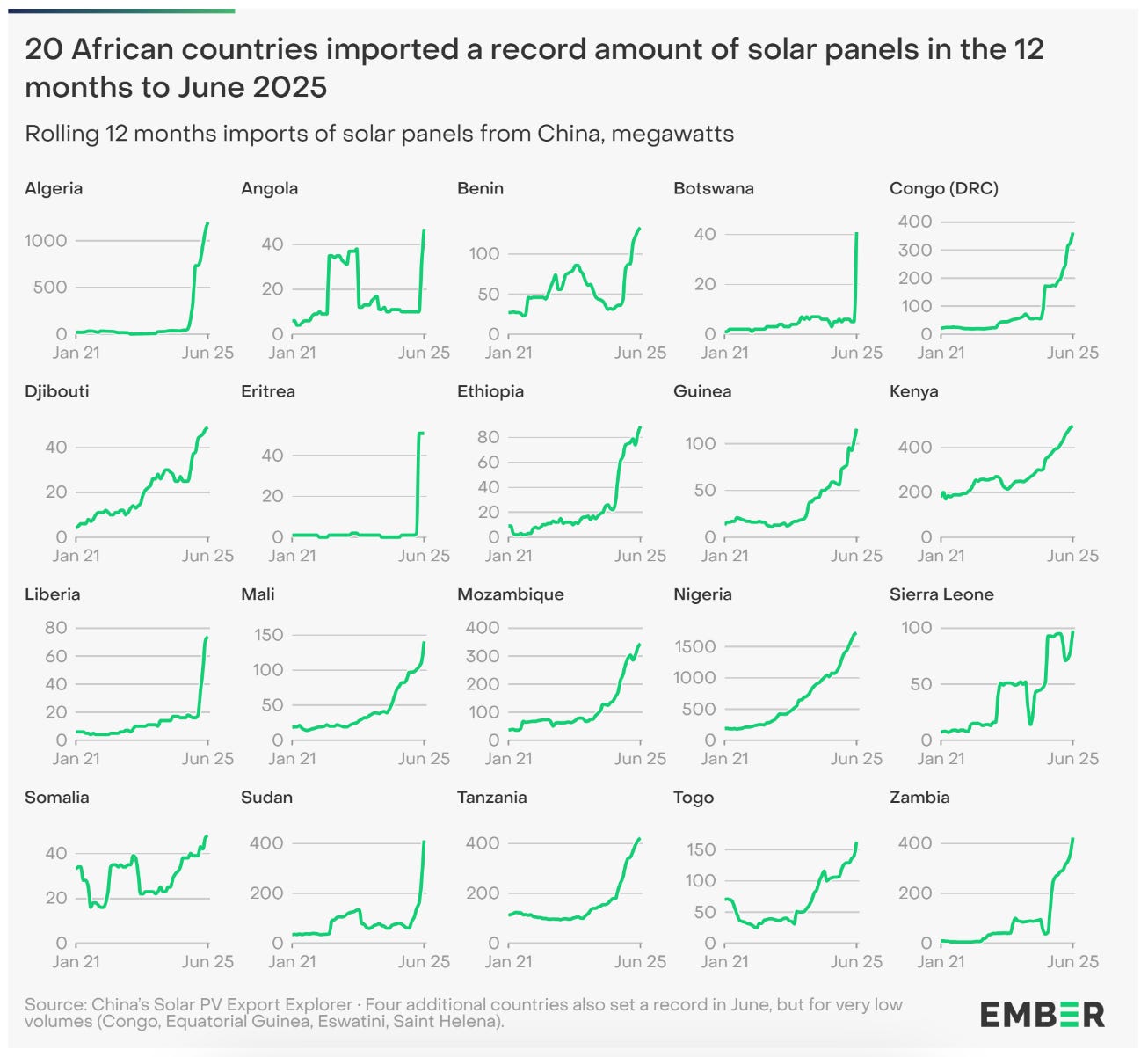
What happens next when so many underdeveloped countries are suddenly awash in cheap, intermittent energy?
The first thing I think of is air conditioning. Consider Lee Kuan Yew’s view that AC was crucial to Singapore’s development:
Air conditioning was a most important invention for us, perhaps one of the signal inventions of history. It changed the nature of civilization by making development possible in the tropics.
Without air conditioning you can work only in the cool early-morning hours or at dusk. The first thing I did upon becoming prime minister was to install air conditioners in buildings where the civil service worked. This was key to public efficiency.
Imagine personal AC units that run off solar panels during the day, supercooling an insulated home so there’s little need for batteries. Many poor countries have hot climates that are only getting worse due to climate change. AC would be so valuable for reducing heat deaths and increasing productivity.
E-bikes also come to mind. Cars are too expensive and developing countries struggle to build the infrastructure to keep up with congestion. Electric bikes and scooters operating on swappable batteries might be the perfect way to get around. This would enable people to get much further than they could before, enhancing agglomeration effects and commerce2.
Another possibility is using solar panels to make fertilizer on-site3. Higher agricultural productivity would free up people and land to work in other sectors.
I hope solar sparks a new industrial revolution in these countries.
Everything else
An Open Source Motorized XYZ Micro-Manipulator - Affordable sub µm Motion Control. You could do incredible things with this. Imagine 3D printing a smaller version of this manipulator with the manipulator itself. Or making photomasks for chip manufacture. Or automating IR chip inspection.
Found seven different solar installation robot companies. But these systems seem complicated. It makes more sense to mount these arms on the back of a pickup truck filled with stacks of solar modules and lay them right on the ground. Or some sort of pre-assambled hinge system like Solarcontainer but without the rails, just unfurl it from the back of a truck. EDIT: the 5B Maverick system is closer to what I’m thinking here (H/T Nadim). EDIT see also: Solar Waves
Whatever Happened to the Self Driving Semi? Great piece on why self driving semi trucks have failed so far. My optimism for caravan-ing was misplaced. Perhaps multiple electric self steering truck beds hitched together with a human driver at the front?
RL Reigns Supreme. I love the term RL-as-a-service. I hope it out-competes the quest for AGI since RLaaS seems much safer than building a machine god.
The railroad bubble in 1800's left lots of rail infra which integrated into our economy. The telegraph lines the railroads needed sparked the telegraph craze. What happens if an AI "bubble" bursts today?
Being honest with AIs. In the future, we will want to cooperate with digital minds. To facilitate this cooperation we should build trust and credibility by being honest with AI’s now and in the future.
Legal Personhood—Three Prong Bundle Theory. Stephen Martin wrote a series on the challenges of applying legal personhood to AI’s. He proposes that we extend personhood to include the requirement that the AI be punishable in the jurisdiction it operates in. Note that the right to be sued is very valuable for being able to cooperate with others, so digital minds may seek ways to be held accountable. Daniel Dennet worried that AI’s would be unsafe for precisely this reason, that there was no way to credibly punish a rogue AI.
Could this reusable metal wall be the 2x4 of the FUTURE? Nice review of the Lada Cube modular construction system. Modular construction has seen a lot of failures, but this seems like a reasonable attempt.
So You Want to Abolish Property Taxes. Suggests a building exemption as a politically-feasible way to turn property taxes into land value taxes.
David Splinter argues that “[t]he U.S. tax system is highly progressive.” I continue to believe a focused, effective redistribution system and an emphasis on economic growth is the best way to help the poor.
Should We Have Patents? Skepticism that patents are the right way to support innovation, though they may work better than prizes due to political economy considerations. Funding early-stage research is probably more effective than either.
Dr. Alexander D. Wissner-Gross has a several interesting papers:
Eviba Carter’s Youtube channel has all sorts of interesting health and skincare advice. I’m skeptical, but it’s too interesting to ignore. A supplement that makes you tan? Getting drunk without the downsides? Chemotherapy as skincare?
Minjune Song was working on sleep-need reduction therapies using gene edits in mice. You may recall from my own post on this topic that I am highly skeptical of this line of work. Minjune has come to the same conclusion and abandoned the gene therapy work. Props to him for making a difficult choice in the face of new evidence. Shame on the scientists who continue to publish low-quality sleep gene studies without making the limitations of their work clear. Minjune has pivoted to building ultrasound devices to induce sleep. Cool!
Calibrating an Ultrasonic Humidifier for Glycol Vapors. Jeff is trialing glycol vapors to reduce airborne pathogens so that his community can safely enjoy contra dances4. It’s fascinating that this might be a cost effective way to fight infectious disease. Stack on UV lighting and sanitation, and pandemics might become a thing of the past.
A shcramjet (yes, I’m spelling that correctly) is a proposed air-breathing jet engine with a funny name.
A multi-stage orbital sky hook for exploration in the new space transportation era. Proposes multiple stages of space tethers to boost payloads to the moon and beyond.
The if the source was easy to find and fix, the pain wouldn’t be chronic!
Perhaps one day, hybrid electric planes and eVTOL’s will be used for air travel.
See also point 3 in this linkpost.
Note that you need very pure water to prevent ultrasonic humidifiers from generating small, potentially damaging particles.
I spoke with Austin Vernon a couple of weeks back on a call about his new storage product. It is very cool and I am hopeful that they are able to get some pilots in place so that the tech can prove itself and start to scale. If the economics hold up as advertised, it will be extremely competitive in the existing long-duration storage landscape.
Airthium seems cool.