
Links #22
Good nanotech finds, there's lots of room for intermittent datacenters, and more.

1.
Nanotech news!
I discovered a new buzzword: Digital microfluidics. Cool video here, the tech seems to be incorporated in Volta Labs’ product. I wonder if you could get the fluids to go up a ramp? Then you’d have a fully 3D lab-on-chip.
Automated iterative Csp3–C bond formation. A 2022 paper from Martin D. Burke’s lab, a method to build linear molecules starting from simple building blocks that can be linked together in an automated fashion. That means we can automate a subset of organic synthesis.
Old paper from Lee Cronin Polyoxometalates: Building Blocks for Functional Nanoscale Systems. These structures remind me of what I thought nanotech would look like when I was a kid. Imagine the tiny metal (oxide) structures growing into a nanobot able to move around an manipulate atoms (more on that in the next section). But alas, polyoxometalates seems to be somewhat of a dead end. They’re extremely interesting as catalysts, but they don’t seem as scalable as semiconductor manufacturing techniques and there’s little prospect of making the structures mobile.
Both Cronin and Burke are part of the broader Acceleration Consortium seeking to automate chemical and materials synthesis.
Biotemplated Silica and Silicon Materials as Building Blocks for Micro- to-Nanostructures. This is a step towards the Diatoms for Microstructured Metal Oxides idea I mentioned here.
Amide technologies has a faster peptide synthesizer that can make longer peptides than is usually available. This is important for modular peptide nanotechnology.
Protein editing using a coordinated transposition reaction. A cut and paste functionality for proteins using inteins. Seems it only works on the periphery of proteins rather than across the protein. Inteins featured in this post as well.
Maverick Metals is using enzymes to extract precious metals from ores.
2.
Electronically integrated, mass-manufactured, microscopic robots. A 2020 paper describing how they made batches of walking robots smaller than 100 micrometers using semiconductor manufacturing processes. Semiconductor processes are important, since the enchippening has made it easy to scale lots of other products.
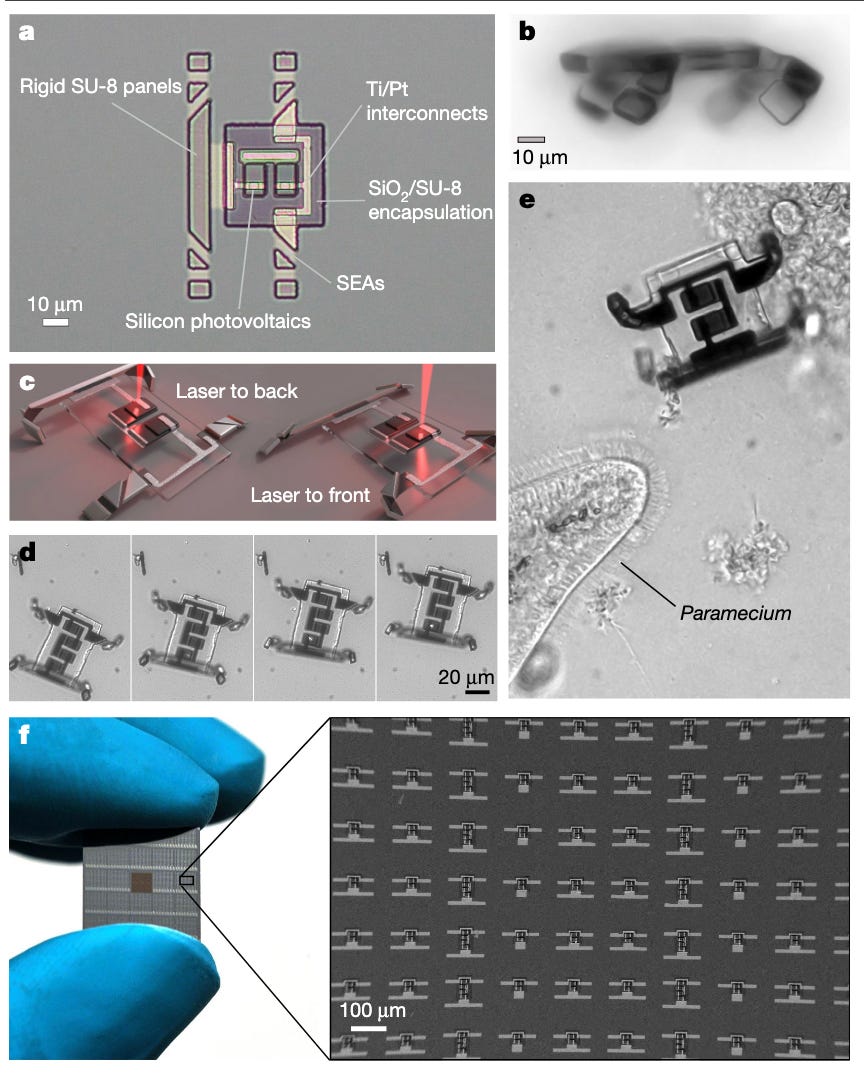
What’s next? Being able to control movement in 2 directions would be nice. Laser light projection through an optical microscope should be able to control a huge number of robots simultaneously. A pick-and-place functionality would allow the swarm to arrange small modules of material.
The robots don’t even need to get much smaller, optical microscopy is limited to a resolution of about 200 nm1. With multiple receiving pads per bot, scaling below 1 micrometer is impractical.
The funny thing about these nanotech advancements is it’s hard to figure out what we need them for. But this kind of research is important because it pushes the Pareto frontier of what we can do. It’s hard to predict what will be valuable in the future, so we have to push on all fronts.
3.
Report on how the electrical grid can add lots of users who are willing to be flexible in their power demand. Find that 76 GW could be added to the US grid without any new additions as long as they can curtail for 0.25% of their uptime. That goes up to 126 GW if they can curtail by 1%. Blog with more discussion here.
To put that into context, the IEA estimates (pg. 67) that world datacenter energy demand could reach 194 GW by 2035 under their “lift off” scenario. So datacenters can easily fit into this curtailment scheme if they can be flexible.
Can datacenters be flexible? I think so. Many operators demand “five 9’s” of uptime for their chips (99.999%) but curtailing from the grid doesn’t mean they have to stop running. Battery backups can cover the handful of hours they need to reduce their usage.
Alternatively, datacenters could accept slightly lower utilization of their chips in exchange for much lower energy costs. For AI datacenters, this might mean using slightly older and cheaper chips at “only” 99% uptime. The lower energy and chip costs might balance the lower utilization and reduce the cost of computation overall.
Everything else
Good Research Takes are Not Sufficient for Good Strategic Takes. Shout it from the rooftops. Experts know about their subfield, not necessarily how to balance between considerations and lead. I would add that experts are often selected for high levels of concern about a topic and have incentives to raise the importance of that topic.
Reflection after Five Papers about Climate Change. The literature suggesting climate change will slow growth is questionable, and the authors of this literature haven’t responded to critiques.
Documentary about some interesting means to make shipping more energy efficient. Some combination of sails, riding currents, bubble shields, better logistics, propellers/hulls optimized for slow steaming, and battery-electric power seem sufficient to decarbonize the industry. It will be a more challenging transition than other industries.
Atmospheric dynamics of first steps toward terraforming Mars
Deep Fission is burying 30-inch wide nuclear reactors deep underground to utilize the pressure and make fission easier. It also protects the reactor from natural disasters and a meltdown down there wouldn’t affect the surface. Neat.
Nice blogpost on VO2max training.
Lifespan of neurons is uncoupled from organismal lifespan. Makes the strong claim that neurons will live as long as the organism lives. Does that suggests that if we solve aging in the rest of the body the brain will survive indefinitely?
Nonlinear sound-sheet microscopy: Imaging opaque organs at the capillary and cellular scale. With the shrinking of ultrasound devices using semiconductor manufacturing this is pretty interesting. Particularly for live connectomics. And the current resolution is same as MRI.
We Can, Must, and Will Simulate Nematode Brains
Scaling Up Reinforcement Learning for Traffic Smoothing: A 100-AV Highway Deployment. Simulates injecting 100 autonomous vehicles into traffic before an upcoming jam. The AV’s learn to clear up the jam, saving time and energy. Very relevant for my post on AV’s and cities.
Short video on using fixed transceivers as an alternative for GPS.
50 Things I’ve Learned Writing Construction Physics
Trammel’s The Ambiguous Economics of Full Automation and David Autor’s presentation Expertise, Artificial Intelligence, and the Work of the Future are good counterpoints to the idea that AI will take all our jobs. Nobody knows, each industry is different, reality is complex.
Five insights from farm animal economics. If you care about animal welfare, normal economic intuitions can be reversed. A factory-farming monopoly would restrict supply of meat, thus reducing lives spent on factory farms.
Scott Aaronson on a recent certified quantum randomness demo. Currently, verifying the random bits takes a lot of computation, but with theoretical advancements, we might get easy-to-certify true randomness. Part of the team also published a perspective on the uses of certified randomness.
What is PLUS times PLUS? A mindblowing video on Lambda calculus.
Super-resolution microscopy techniques don’t appear helpful for this application, because they typically involve inhibiting nearby fluorophores or partially exciting the sample. This would slow down nanomanufacturing which is probably impractical. Better to scale down the payload or increase the position resolution of the bots.