
Links #33
New theories of dementia, synthetic protein, land taxes fall on the rich, assorted science links.

The first section below is quite long and probably should have been its own post. My apologies.
1.
There are some interesting theories about metabolic dysfunction and Alzheimer’s. At this point, it’s doubtful that Alzheimer’s has a single clean cause, but each contributor is a treatment opportunity.
Vascular dementia is the second most common form of dementia. It happens when blood vessels damaged by heart disease become less effective at supplying the brain1.
Vascular dementia is considered distinct from Alzheimer’s, but Alzheimer’s brains also exhibit lots vascular damage. This paper hypothesizes that Vascular dementia and Alzheimer’s are consequences of the same underlying damage to the brain’s blood vessels.
One of the authors on the paper, Jack de la Torre, believes that amyloid plaques observed in Alzheimer’s are a symptom of poor perfusion. They serve to exacerbate the disease2.
This is exciting because at the very least it gives us new way to try to predict dementia risk. For instance, this 2006 paper uses PET to distinguish Alzheimer’s from vascular dementia.
At the other extreme, this paper makes the striking claim that neurons with good blood flow don’t age at all:
Lifespan of neurons is uncoupled from organismal lifespan
The story relating dementia to failures of perfusion fits with the discovery that the shingles vaccine prevents dementia. It’s thought that shingles reactivation can lead to inflammation and damage of blood vessels among other things.
A related line of work connects Alzheimer’s to dysfunctional glucose metabolism. One clue is that people with type 2 diabetes have double or triple the risk of getting Alzheimer’s, with some calling Alzheimer’s “type 3 diabetes”.
Alzheimer’s Disease is Type 3 Diabetes—Evidence Reviewed
Oxidative stress, dysfunctional glucose metabolism and Alzheimer disease
Also interesting is that intranasal insulin temporarily reduces dementia symptoms. This could be because insulin resistance reduces uptake of glucose from the blood3. Exogenous insulin forces the neurons to take up more glucose. See also:
Insulin Resistance and Alzheimer’s Disease: Bioenergetic Linkages
Maybe this is why old people really like sweets. Their brains are not getting enough energy due to vascular problems and insulin resistance. They compensate for the ineffective energy transport to their neurons by raising blood glucose.
In the book Transformer4 Nick Lane relates a theory that neurodegenerative diseases that connects to the theories above. There are some connections between neurodegenerative diseases and diabetes-induced malfunction of the mitochondria:
Sweet Mitochondria: A Shortcut to Alzheimer’s Disease
There is also work connecting neurodegeneration with mitochondrial dysfunction more broadly:
Mitochondria, OxPhos, and neurodegeneration: cells are not just running out of gas
This paper goes further, aiming to explain why this mitochondrial dysfunction leads to the formation of amyloid:
Mitochondria-associated ER membranes and Alzheimer Disease
ApoE e4 gene is a major risk factor for Alzheimer’s and is implicated in all of this. The protein it codes for plays a role in cholesterol transport (thus heart disease), glucose metabolism, and mitochondrial function.
Tying it all together, dementia and other neurodegenerative diseases might happen because neurons are not getting enough energy. Heart disease makes blood vessels worse at their job. Insulin resistance prevents cells from importing glucose from the blood. Mitochondrial malfunction prevents cells from converting that glucose into useful work. The energy deficit results in amyloid production which damages neurons further. Aging exacerbates these problems.
Solving dementia might require addressing every step. Fortunately we’ve seen remarkable progress on heart disease and insulin resistance (GLP-1’s, SGLT-2 inhibitors). We have several monoclonal antibodies to clear amyloid5. A handful of people are taking on aging directly. But perhaps mitochondrial malfunction deserves more attention.
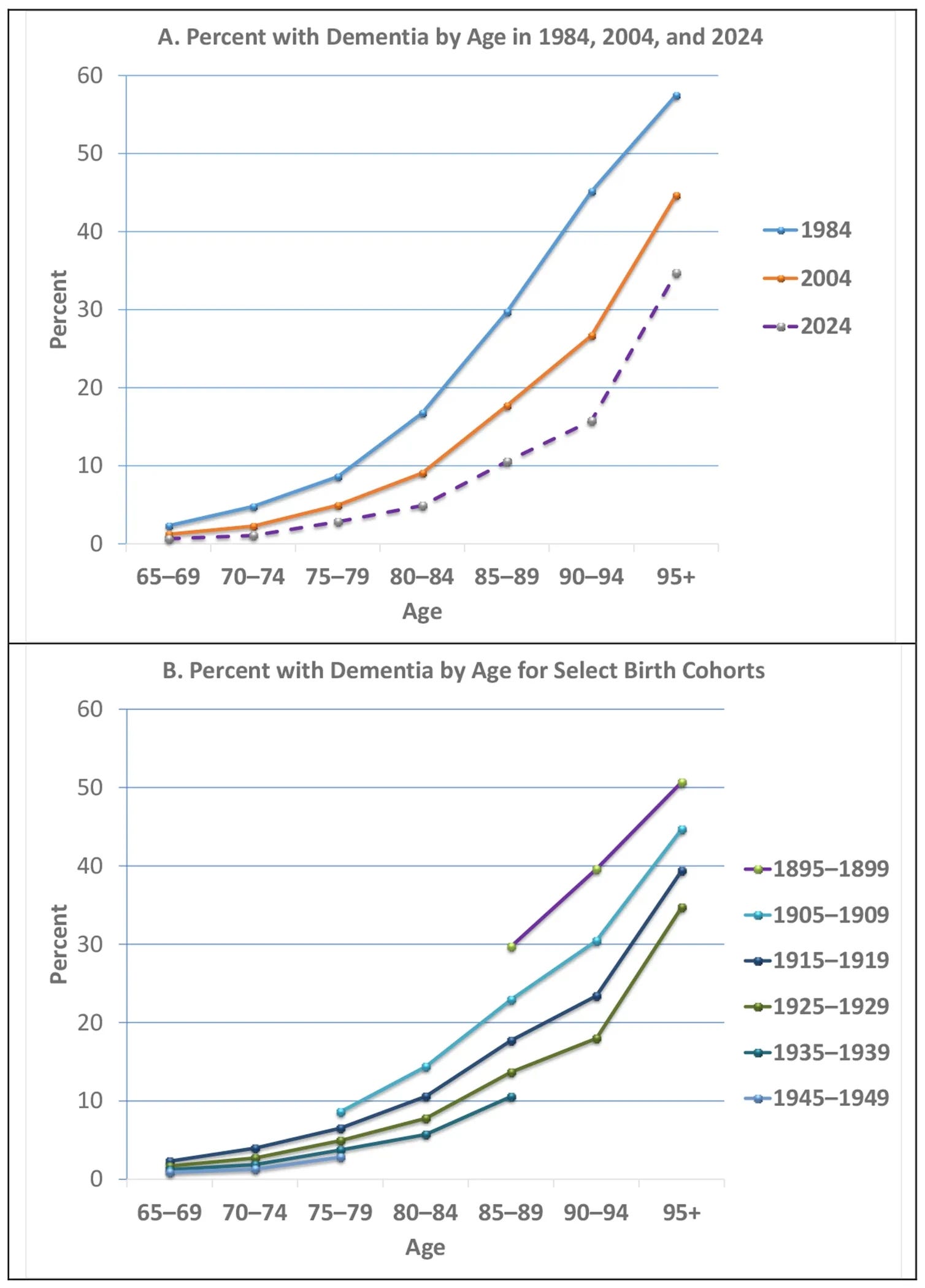
Progress is possible here. Dementia rates have fallen a lot on their own. I’d guess this is due to less smoking, vaccines, and statins:
2.
Defeating death is pretty valuable, in some squishy human sense but also in terms of cold hard cash. The Economic Value of Eliminating Cancer estimates that “[e]liminating cancer mortality generates $197 trillion in economic benefits over 35 years”. Silver Linings has a nice site about estimating the value of extending lifespans, fighting dementia, or slowing reproductive aging.
There’s been progress on the two biggest killers in the developed world, heart disease and cancer. For heart disease see: Matthew O’Connor on Cyclarity’s Successful Phase 1 Trial. Cyclarity has an interesting drug platform and claims their new drug might reverse atherosclerosis. Exciting.
Cancer has seen even more progress see this nice review by Saloni Dattani.
Owlposting covers How to build a cancer vaccine, and whether they will work this time.
Finally, something more speculative, in vivo CAR-T. This is a remarkable technique to deliver genes or mRNA to T-cells in the body, training them to combat cancer. This has the potential to be cheaper and easier than traditional CAR-T.
In vivo CAR-T cell therapy: New breakthroughs for cell-based tumor immunotherapy
By the way, CAR-T and other immunotherapies are finding their way into treating autoimmune diseases. Ruxandra Teslo thinks we might be able to borrow the same tricks to fight aging:
Autoimmune therapies: an inspiration for anti-aging therapies?
3.
EVERY is a company that makes animal proteins from precision fermentation. Jeff Kaufmann says it works in baked goods and DIY Biotech tries it in scrambled eggs. It’s more expensive ($0.53 per EVERY egg white vs $0.21 for traditional) but it’s very promising that precision fermentation was able to get the costs to even approach store bought.
I’m curious about the things you can do with animal-free powdered egg whites. Egg cocktails without the risk of getting sick, more concentrated foams and sauces, shelf stable egg whites in your pantry, etc.
The exciting part is that producing just this one protein (ovalbumin) means we’re pretty close to making synthetic eggs. Egg yolks are just fat, lethecin, and micronutrients. Replacing eggs with something healthier and cheaper would be a big win for animal welfare. Next up is milk, which is just some protein, plus fat6 and sugar (that nobody wants).
On a less appetizing note, you can feed microbes methane to get a food source that isn’t reliant on agriculture at all. This is important for preparing for certain catastrophes. Society’s Resilience to a Total Loss of Agriculture finds that 16% of annual US gas production could feed the population for a year. And US has enough reserves to feed population for 500 years!
We’re approaching a world where synthetic food is possible. The question is whether anyone will eat it.
4.
Civic Mapper is a neat tool to visualize land values in various cities. The image below shows downtown Cleveland.
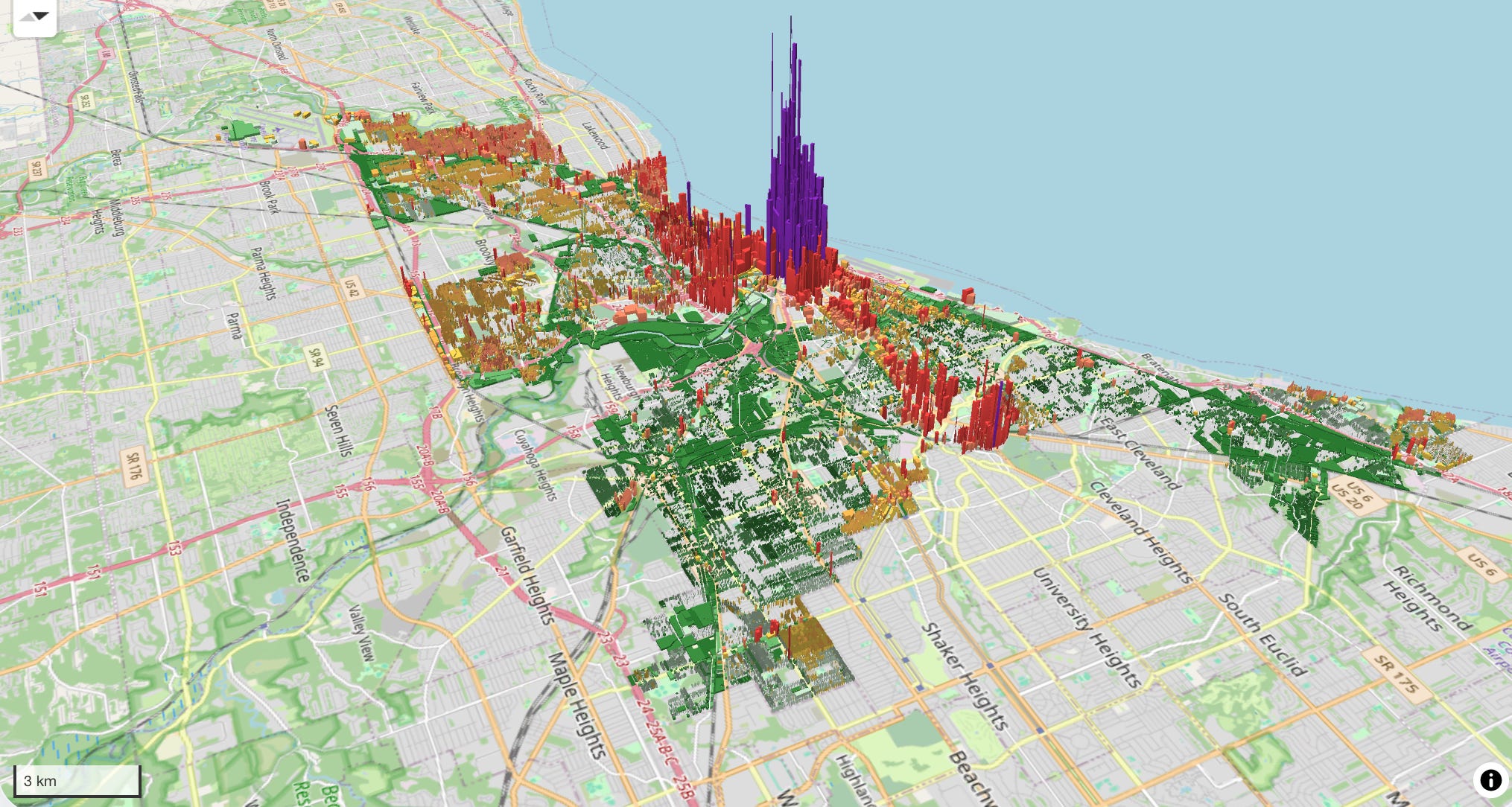
The land in the purple areas is easily 100x more valuable per square foot than the green areas. The gap would be even larger for outlying towns and fields. This is consistent other data suggesting that urban land would make up the large Majority of land value tax revenue.
Land value taxes are highly progressive. They fall mostly on the rich and on corporations. And they are one of the most efficient forms of taxation.
Everything else
The perfect city? a podcast interviewing Ed Glaeser with a striking claim:
“Forty years of transportation economics at Harvard can be boiled down to four words. Bus good, train bad.”
Glaeser is also a fan of congestion pricing. Good discussion of city design and implications for developing countries. I think Flying cars and AV’s are going to change this a lot.
Abundance from Abroad: Migrant Income and Long-Run Economic Development and pair with: Emigration for Growth. Both argue that emigration plus remittances can significantly boost economies in the developing world.
Malaria is not just a health crisis, it is an economic crisis. Paper suggests a 75% effective malaria vaccine would raise incomes in Africa by almost 10%. Disease burden is one thing that’s keeping sub-Saharan Africa poor. Stack on the recent HIV preventative and the gains might be even higher7. Could this boost unlock long-term growth in these countries?
Is modernization widening cultural differences? Some evidence that culture is becoming more diverse, contra claims about a globalized culture. See also: Music markets remain deglobalized.
Beginner’s Guide to Arguing Constructively and Disagreeing charitably with others offer good advice.
Managing Relationship Decay: “The decline in friendship quality was mitigated by increased effort invested in the relationship, but with a striking gender difference: relationship decline was prevented most by increased contact frequency (talking together) for females but by doing more activities together in the case of males.”
The Unexpected Persistence of John Rawls. Classical liberalism as a meta-theory of ethics where all groups are free to pursue their own ends.
“Everything’s Expensive” is Negative Social Contagion. Sticker prices have gone up, but in real terms things have gotten better.
“… ‘stuff is pricey’ mostly serves to make people feel bad. And in aggregate, this is actually a problem, since it contributes to people thinking “the economy” is bad any time prices are rising, and when people think “the economy” is bad they want to rock the boat and make facially insane political choices.
The internet has increased negative social contagion. You can combat that by not giving in and giving less attention to negativity.
Aurelia has two posts on brain preservation and why they believe preserving the high-level structure of neurons is sufficient for cryonics:
Why do I believe preserving structure is enough?
Does preservation make sense before we know how to revive?
Do you really need a brain at all? Considers cases where peoples brains have been severely damaged yet retain a surprising amount of function. Discusses implications for brain preservation.
Andy McKenzie frames the questions from the above posts nicely: It seems easier to simulate a nervous system than a cell.
Induction of cortical on/off periods in awake mice fulfills sleep functions. Uses light to activate brain regions and mimic some of the benefits of sleep while the mice are awake. Interesting for Sleep need reduction therapies.
Acadesine is an interesting drug. In mice, seems to improve cardiovascular endurance. Even without exercise it activates many of the genes associated with cardio.
Two highlights from List of Biotechnology Companies to Watch – AI Expanded Version:
Bexorg which uses post-mortem human brains to do drug development.
Cognito Therapeutics Audio and visual stimulation of Alzheimers patients to slow the progression of the disease.
“Human Operator is a human augmentation tool that allows AI to briefly take control of your body to help you learn and do things you normally cannot do.” Hmm.
Systolic arrays for general robotics, AI, and scientific computing. Google TPU's are designed around systolic arrays, an idea from the 1970's:
"... Kung’s group didn’t stop at matrix multiplication, they presented a concept of systolic networks of arbitrary processing nodes that could do way more."
Very interesting, rhymes a lot with agent orchestration stuff.
Sakana Fugu — Multi-Agent System as a Model. Orchestrating different AI models carefully produces better performance than any alone. This accelerates competition between inference providers.
Are we reaching "peak combine-harvester"? Combine harvesters got more efficient by growing larger. But now we’re approaching the size limit due to issues of soil compaction, among other things. The next step is self-driving harvesters.
Some nice discussion of sling launchers (i.e. space tethers) on the moon:
Lunar Sling Launcher - Tether Dynamics
Lunar Sling Launcher - Release Mechanism
Heart disease can lead to a stroke, which produces a more severe form of vascular dementia. Fortunately, medical advancements have made this less common than subcortical ischemic vascular dementia.
For more on the theories of Alzheimers discussed here, I’d recommend Outlive by Peter Attia pages 194-197.
Something that complicates this theory is that neurons have alternative mechanisms for glucose uptake. They shouldn’t be as dependent on insulin for driving uptake.
With disappointing results so far. But perhaps now we know why.
Which we try to get rid of and which can be made synthetically.
Developed countries only vaccinate for a handful of things, and yet few infectious diseases persist in the developed world. Most disease eradication came from sanitation, in turn made possible by economic growth. Consider Tuberculosis, it’s a major cause of death in SS Africa yet rare in developed countries. There isn’t an effective vaccine for it yet, but good ventilation has made it rare in developed countries.
Thank you for including my piece on combine harvesters from last year in your round up.
Nice links! I personally think that the idea that the shingles vaccine preventing dementia is most likely just a confound, like so many other things in dementia research. Here's an intriguing take on the topic, probably too strong but I'd guess most likely directionally correct, i.e. the effect is probably largely just a confound. https://www.drvinayprasad.com/p/shingles-vaccines-and-dementia-the