
Links #31
My bluesky threads, Em's are coming, new tech in the developing world, and much more.

1.
I use Bluesky for my microblogging. The AI scene is good there now. Though I’d like to see more science and econ stuff.
A thread from me on AI in 2026:
Pair with this thread on how LLM’s change the internet. I think ATproto (the protocol behind Bluesky) is well positioned to take advantage of these changes.
2.
Brain emulations are coming. From Konrad Kording’s end of year post:
The phrase “simulating nervous systems” used to trigger eye-rolls because it sounded grand and vague. In 2025, it felt more like an engineering roadmap with increasingly nontrivial milestones.
See his paper The time is ripe to reverse engineer an entire nervous system: simulating behavior from neural interactions.
Max Schons has a beautiful report on brain emulation:
State of Brain Emulation Report 2025
And a companion piece on Asimov press:
See also: Notable Progress Has Been Made in Whole Brain Emulation — LessWrong
Related: Low-cost 3D-printed optics for super-resolution multifocal structured illumination microscopy. They 3D printed one of the lenses in a microscopy setup, making it much cheaper.
These are the kind of innovations we need if we’re going to make optical microscopy far cheaper and faster. In my mind, optical microscopy (with expansion microscopy and barcoding) is the most scalable method to scan connectomes.
3.
A few items on technology and the developing world. First, an old thread from me on financial technologies in the developing world. Those financial technologies are a big reason Why Solarpunk is already happening in Africa.
Local grids are failing people in Africa. People are using the mobile money system to take out loans to buy a personal solar and battery system. That means saving the money spent on kerosene for indoor lighting. That means being able to work and study for more hours of the day. I hope this unlocks a self-reinforcing cycle of productivity.
Also of note:
allenai/HiRO-ACE. An open-source weather model that uses AI to predict precipitation weeks or years in advance. Imagine farmers across the world using models like this to optimize crops or buy insurance.
The changing (and perhaps surprising) geography of diabetes. As the developing world grows and enjoys an abundance of calories, diabetes is rising. For the same BMI, some ethnicities get diabetes at higher rates. The developing world is going to need a lot of GLP-1’s.
Everything else
OxLDL-Targeted Chimeric Antigen Receptor T Regulatory Cells Reduce Atherosclerotic Plaque Development. CAR-T therapies to prevent atherosclerosis. Seems a bit overkill when statins can probably prevent atherosclerosis in the first place. But I’m all for developing cellular nanotech.
A Nonviral Neo‐Nucleocapsid for Cell‐Specific RNA Delivery Developed by Pseudo‐Cyclic Peptide Grafting and Directed Evolution. More cellular nanotech.
EVIO Aircraft. A planned hybrid-electric plane with 900 km range, 76 passengers, and quiet takeoff and landing. Important if we’re going to make flying clean and quiet so we can build more airports and air busses.
Terraforming Venus Quickly. Old paper from Paul Birch that aligns a lot with a post I’m writing.
Do Commodities Get Cheaper Over Time? Probably the most comprehensive data on long term commodity prices I’ve seen. My take: the theory of exhaustible resources suggests commodities should grow in price at least as fast as real interest rates. The data is consistent with real interest rates in the U.S.1
Most people are individually optimistic, but think the world is falling apart. Might I suggest that social (and traditional) media is selling you lots of pessimistic and misleading information creating a situation where views on “the world” are completely divorced from reality and people are mostly fine?
Pro-social media. AI’s telling users the truth and being a public arbiter of truth may ameliorate some of the problems of social media.
What do executives do, anyway? A management strategy for large companies that coordinates everyone around a set of values and enforces those values, delegating all decisions to lower parts of the hierarchy.
To paraphrase the book, the job of an executive is: to define and enforce culture and values for their whole organization, and to ratify good decisions.
That’s all.
Not to decide. Not to break ties. Not to set strategy. Not to be the expert on every, or any topic. Just to sit in the room while the right people make good decisions in alignment with their values. And if they do, to endorse it. And if they don’t, to send them back to try again.
Is this secretly a manifesto for orchestrating AI agents?
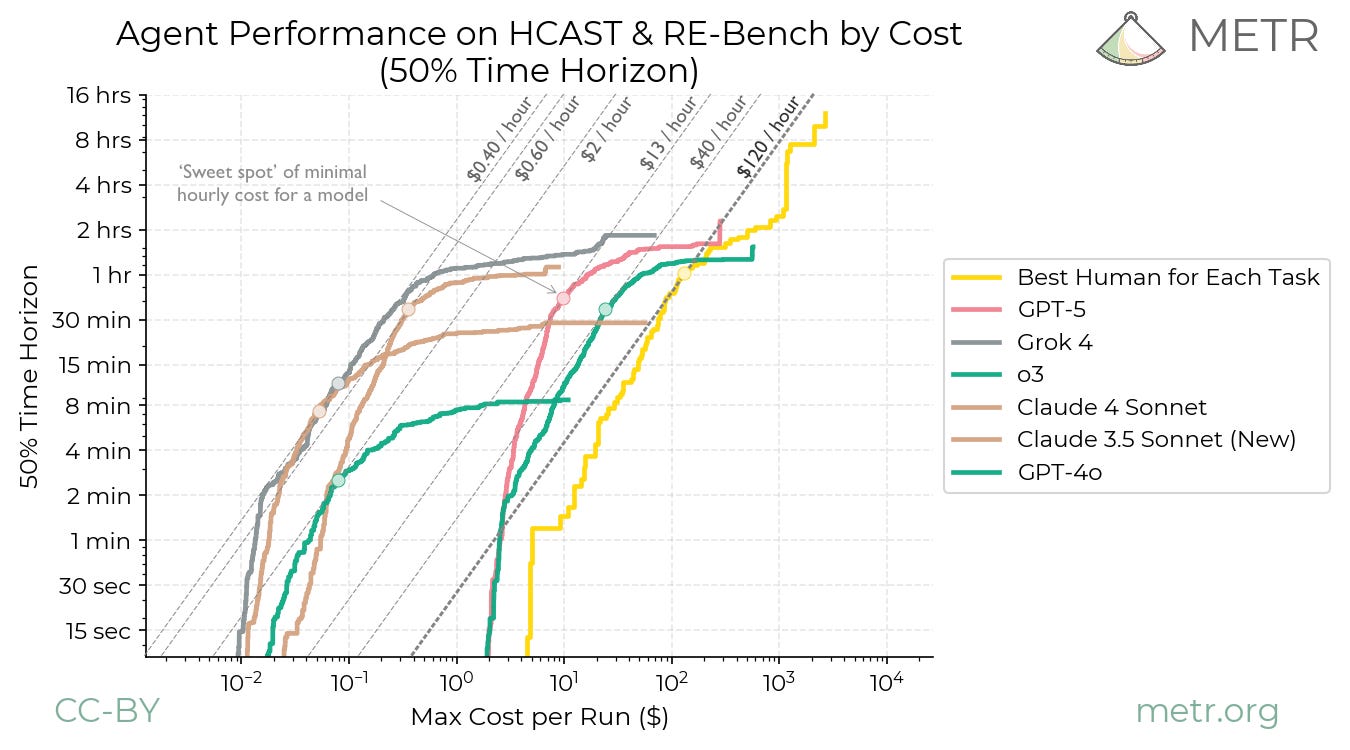
Are the Costs of AI Agents Also Rising Exponentially? — Toby Ord. The METR time-horizon curve looks different when you consider how models perform when given more resources. More advanced AI agents can do more, but also command higher hourly wages. Models will continue to improve in every aspect, but reality is more complicated than looking at the METR plot and extrapolating to singularity.
On neural scaling and the quanta hypothesis. Toy model reproduces AI scaling laws by assuming that A, knowledge is in discrete pieces (quanta), B quanta are either memorized or not, and C, “[t]he ‘use frequencies’ of the quanta naturally follow a power law.”
Tuning GPT-3 on a Single GPU. Old paper from Greg Yang applying theories of infinite-width neural networks to the real world. You can optimize the training hyperparameters of a small neural network (40M parameters) at small scale and then transfer them to a larger neural network (6.7B parameters). Might we “solve” training hyperparameters once we optimize them for a 1B parameter model?
The Advanced Matrix Factorization Jungle. Incredible reference on niche matrix factorization methods, particularly when you want to enforce things like sparsity.
2000-2020, the modal annual price increase for commodities was 1.5-2.0%, compare with real interest rates ranging from 0.5-2% over the same period.
3.
> Local grids are failing people in Africa. People are using the mobile money system to take out loans to buy a personal solar and battery system. That means saving the money spent on kerosene for indoor lighting. That means being able to work and study for more hours of the day. I hope this unlocks a self-reinforcing cycle of productivity.
This is something I've been thinking about lately.
The most successful model for nations that I know of that takes them from Low Income --> Middle income --> High income seems to be export-oriented industrialization. It worked for basically every major success story since WW2 besides microstates that have some strategic advantage (Singapore w/ location, various tax havens, etc.), or states that have a large amount of valuable natural resources that they manage well (Norway, Gulf States, Botswana, etc.).
I worry that this sort of development model is not viable with solar power, which is variable throughout the day and year. Factories need to be operating nearly 24/7, so even if you have the cheapest labor on the planet, you'd need quite a lot of solar panels, and quite a lot of batteries to run factories off them (Unless you have a large functional power grid already that can pick up the slack).
My admittedly unfounded suspicion is that the adoption of solar power in Africa is going to be harmful in the long run. It will divert focus from having an "industry capable" power grid, and I don't see much of a path to development without industrialization, especially given that much of Africa doesn't have the same education-focus as the East Asian economic miracles had in their cultural backgrounds.
Essentially; Short term gains from having access to power in places without consistent electricity generation. Long-term stagnation as cheap solar replaces power sources capable of powering industry, leaving no competitive advantage besides resource extraction. All perpetuating Africa's underdevelopment.
Edit: And automation makes this even worse, as the competitive advantage of extremely cheap labor willing to work in arduous and unsafe conditions gets weaker when you're competition with a billion humanoid robots, or whatever it is that Tesla and Boston Dynamics are doing with robots. I'm not convinced on the viability of that dream, but I think it's plausible, and could make development even harder for Africa.