
Links #30
Inside a dating app, childcare and freedom, the vibecession, and science news.

What really happens inside a dating app (H/T Dynomight).
Set aside your judgement and see this post as describing empirically how dating apps work. Push through the confusing sentences and you’ll find a wealth of information about human behavior.
The appendix of this post has more notes, but some things that jumped out at me:
The apps have solved the recommendation problem. “Recommendation of profiles that you may like is a solved technical challenge at Tinder level and at mostly any dating app today.”
Retention of users is the only thing that matters for these compamies.
Retention depends entirely on a personalized feed algorithm.
The key to produce the best feed algorithm (if you target retention) is personalization more than recommendation. Of course seeing users that you really like every once in a while will increase your retention. But what really increases retention is understanding what each user wants. And we all want things different. Some people will want to see only a few people that they like a lot, some people will want to see a lot of users. Some people will want to see people that are far from them, some close, some can’t stand seeing people they don’t like, some can’t stand seeing people they only like. Some want to receive a lot of likes, some want to receive a few likes
Current dating apps are local optima. “What makes you keep scrolling on TikTok or YouTube or Instagram? It is the feed, it is the same on a feed-based dating app. Pursuing retention will just bring you to recreate Tinder.” To create something new, you need to aim at something other than retention.
One theme that lacks a pithy quote but seems to run throughout is that people want attention. They like getting matches and talking to people. I think this is a deep part of human behavior and drives a lot of social dynamics.
2.
Parents’ effective time endowment and divorce: Evidence from extended school days. When the school day is extended by 3.5 hours, mothers can work their own job and gain economic independence from their husband. This leads to an increase in divorce rates.
It’s a good thing that childcare gives these women the opportunity to work, to support their family, and to leave bad marriages.
How do we scale childcare? Baumol’s cost disease threatens to make it perpetually expensive. One option is to make it universal and government-run. Though this misses out on possible efficiency gains. A voucher system might work, effectively subsidizing childcare while allowing the market to find good solutions.
But neither of these address the risk of education signalling spirals like we see in South Korea. What happens if all this subsidized childcare turns into a red queens race of exam study?
In a more reasonable world, we would recognize that new technology means students can keep up with the curriculum with a mere 2 hours of work per day. Older students would be able to speedrun several grade levels, there’s no need to teach certain concepts so early. The rest of their time could be spent on the playground and they would turn out just fine.
But I don’t know how to coordinate everyone around that idea1. Seems important.
3.
ACX has some good discussion of why the economic vibes are bad:
Vibecession: Much More Than You Wanted To Know
Highlights From The Comments On Vibecession
They offer many tantalizing possibilities, but we should keep things simple. Peoples vibes are completely unreasonable and unmoored from reality. Instead, the main thing bringing people down is more media consumption and negativity in the media. This explains the long term and global reduction in vibes since ~2010.
Several things exacerbated this emotional sentiment:
Post-pandemic inflation lowered some peoples real incomes and made others feel poorer because of the money illusion.
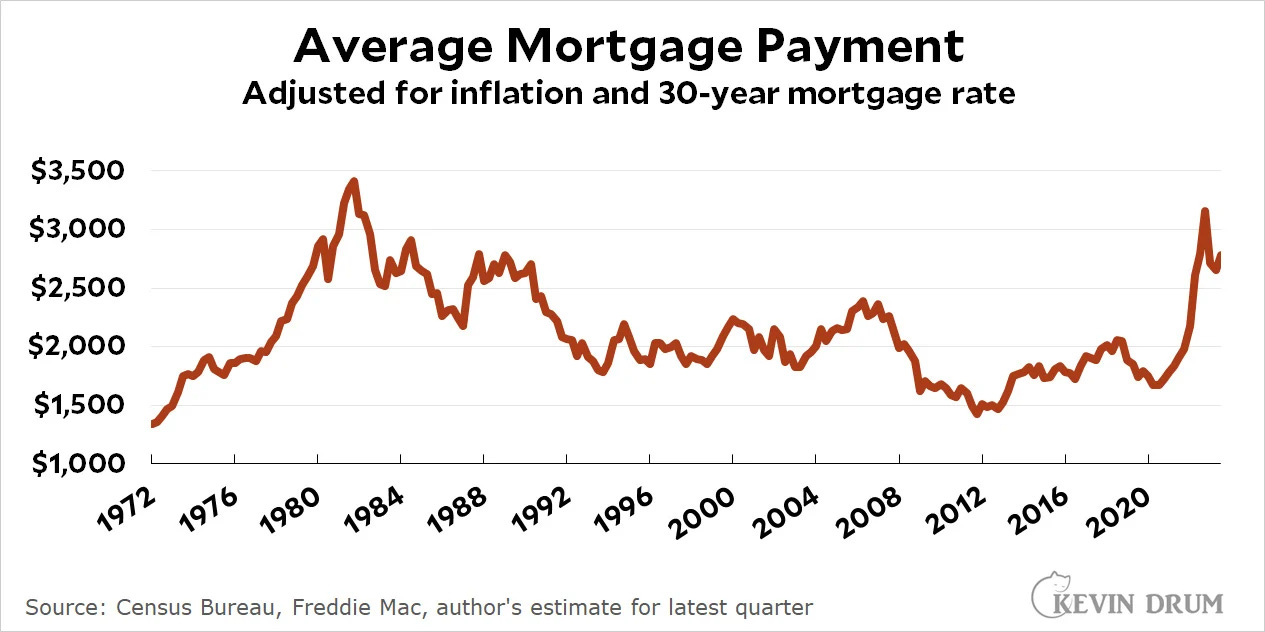
The price of buying a house (see image) rose sharply because of COVID, persistent inflation, NIMBYism, tariffs, and immigration crackdowns. Rents have increased slightly. But rents in highly-desirable metro areas where all the exciting opportunities are have increased more.
Removing application frictions in college apps, job apps, and dating makes people experience more rejections. They’re doing more work to stay in the same place.
On top of all of this, Zvi points out that people expect more out of life than they did before. In addition, regulations in childcare, healthcare, education, and housing make some necessities far more expensive. Much more at the post.
So, what are we going to do about it? Obviously better policy can address many of the bullet points. But that doesn’t face the broader problem of negativity in the media. This isn’t the first time I’ve bumped up against this problem. A previous linkpost started with the decline in marriage and ended up here:
But really staring into the abyss requires recognizing that better and cheaper entertainment media is interfering with our social fabric. I’ll never suggest regulating internet use, but maybe giving students a Defense Against the Dark Web class would help. I’ll have to think more about this.
I get the sense that the internet is driving a wave of negativity, damaging our social fabric and driving people to unreasonable beliefs. This makes voters more unreasonable. This drives bad policies which produce stagnation.
The internet has brought many wonders, but how do we patch this?
Everything else
Money Doesn't Buy Elections. It Does Something Worse. Proposes that donors influence who is able to run for elections rather than influencing voters. This gives them control over what policies are acceptible.
Vagus nerve-mediated neuroimmune modulation for rheumatoid arthritis: a pivotal randomized controlled trial. Another win for treating ailments by manipulating the brain.
We Induced Smells With Ultrasound
Memazing. Sebastian Seung (one of the leading connectomics researchers) is starting a brain uploading company.
Microscopic-Level Mouse Whole Cortex Simulation Composed of 9 Million Biophysical Neurons and 26 Billion Synapses on the Supercomputer Fugaku. What happens when a crappy neural simulation starts talking to us? Just turn it off?
AI infrastructure in the “Era of experience”. Another great post from the Tensor Economics blog. Essentially argues that RL-as-a-Service will come to dominate. Goes into technical detail on how datacenters can serve many fine tunes of the same base model (multi tenancy). These fine tunes will be in the form of LoRA adapters trained on proprietary data. Training can get also get gains from multi tenancy and LoRA. See also my piece on Economic futures for LLM inference.
RF Over Fiber: A New Era in Data Center Efficiency. Two companies are using plastic waveguides to send radio waves between chips. This allows for the type of high-bandwidth connections needed in the age of AI. They think it will be cheaper, more reliable, and more energy efficient than optical interconnects.
Antimatter Development Program
Appendix on dating apps
Profile photos
Profile picture is pretty much the only thing that matters for determining if someone likes another person.
The percent of people who like your profile is sufficient to measure hotness. You don’t need ELO or anything fancy.
Attractiveness in real life is distinct from profile photo attractiveness. Generally women look better in photos while guys look better in real life. Attempts to level the playing field by having people take videos didn’t work because women didn’t like how they looked in video so wouldn’t join.
Other profile info
People are willing to fill out lots of information about themselves. This information is virtually useless for matching people. But people like to do it so it’s included as part of the user experience.
People are terrible at telling you what they want, their inputs are useless. 2-3 go/no-go parameters is all that is helpful.
Women sometimes use this other profile information to filter out certain men. Older women put more emphasis on it.
The feed algorithm
“Recommendation of profiles that you may like is a solved technical challenge at Tinder level and at mostly any dating app today.”
BUT you can’t just feed people matches that you think they will like. New users need some activity on the site before you know what they like. And these new users need to be reviewed in turn by other users. “People don’t want to see only users that they like, girls actually adapt their behavior if they see too many guys that they like.”
“The key to produce the best feed algorithm (if you target retention) is personalization more than recommendation. Of course seeing users that you really like every once in a while will increase your retention. But what really increases retention is understanding what each user wants. And we all want things different. Some people will want to see only a few people that they like a lot, some people will want to see a lot of users. Some people will want to see people that are far from them, some close, some can’t stand seeing people they don’t like, some can’t stand seeing people they only like. Some want to receive a lot of likes, some want to receive a few likes”
“The feed algorithm is the only thing that will impact the retention of users on your app. Everything else almost doesn’t matter.”
Lots of tricks in the feed such as showing women a mix of guys they actually like, guys they feel they are supposed to like, unattractive men. You also want to ensure women are receiving a stream of likes and messages, so men’s feeds might be oriented towards seeing women that haven’t gotten sufficient likes today.
Women seem to like a fixed percentage of the profiles they see. That means the context of other men in their feed affects how often they like a particular guy.
“Girls scroll about 2 times more than guys. (Fortunately). First, the like ratio of girls is 4%. So to be able to like 4 guys they have to see 100 users. And for a guy, it is 18 users. It also means the experience on a dating app for a girl is completely different than the one for guys. A girl spends a lot of time just searching for guys she will like, and guys spend a lot of time hoping a girl will like them back.”
Retention
The main focus for apps like Tinder and Bumble is retention of paying users.
Apps have monetized and it hasn’t changed the experience much. Men pay.
For women, only thing that drives retention is number of likes sent. At the beginning, the most important thing is seeing a match quickly after signing up.
For men, nothing seems to impact retention much.
Need to do moderation on what accounts are allowed. Obvious fake users hurt the site. Subtle fake profiles exist and don’t have a big negative impact. Their site blocked ~all of them and didn’t impact retention much.
Current dating apps are local optima
“What makes you keep scrolling on TikTok or YouTube or Instagram? It is the feed, it is the same on a feed-based dating app. Pursuing retention will just bring you to recreate Tinder.” To create something new, you need to aim at something other than retention.
Dating apps provide entertainment, not dating
Some people just want to chat on the apps and meet others, they don’t really go out.
Some people just match up well and end up meeting in real life, but there’s not much the app designers can do to change that for the better.
“People were not speaking for very long conversations in general, they were happy to start a chat, but never really cared to continue it. Which always makes me say, that people registered on these apps are not really here for dating, but more for entertainment purposes.”
Aggressively tax education spending past a certain level? Pass/fail for all classes? Base all admissions on test scores alone?
I feel like there's some overlap between this and women's liking behavior on dating apps: https://youtube.com/shorts/2jUx8myk6-k?si=A_HKIemXDm1oCmPw