
Replace income taxes with better ones
Externalities, land taxes, and consumption taxes are sufficient to fund the government.

Tax systems are mostly a solved problem. Experts agree that taxing externalities, land, and consumption are better than taxing income. But income taxes form the bulk of tax revenue in developed countries. Could we replace them with a better tax?
Revenue
Can we generate enough revenue with externalities, VAT, and LVT? My goal is for the tax system to cover local, state, and federal tax revenues rather than spending. The fact that states spend more than their growth can compensate for is another problem entirely.
The federal government brought in $4.5T in 2023. State and local taxes brought in $2T in 2023 (though I’ve seen conflicting estimates). So we need to generate $6.5T in revenue.
How much revenue would we get from taxing externalities? This obscure blog post is the best resource I’ve found. Assuming we only tax driving and alcohol consumption, that generates revenue equivalent to ~2.2% of GDP, or $0.6T.
I’ve estimated that my LVT plan would generate $2T at a 5% rate, so let’s assume a 10% LVT would generate $4T1, though see the disclaimers in that footnote.
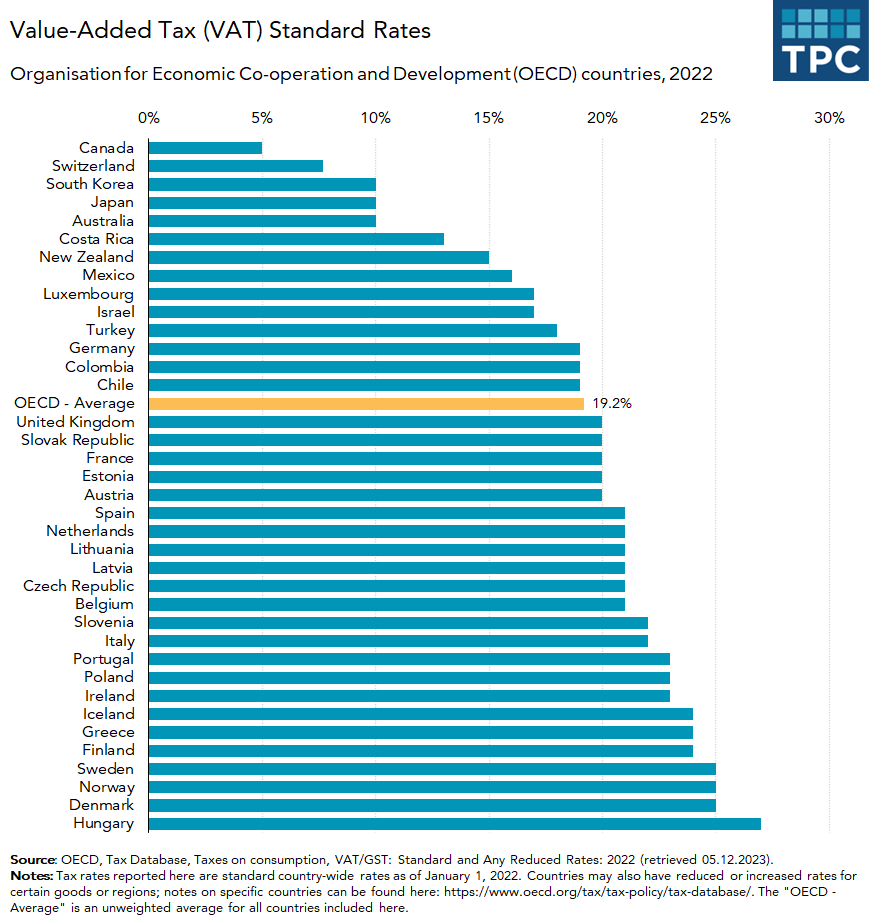
To cover the remaining $2T, I propose a VAT of 15%. This is in line with most countries and is lower than typical rates found in Europe2. It’s hard to find estimates of how much a VAT would generate. Table 3 in the report Raising Revenue with a Progressive Value-Added Tax lists a “Consumption in VAT base” of $11.8T in 2020, which would be $13.9T in 2023 dollars. A 15% tax on that would generate $2.1T in revenue. This seems in line with the Toder and Rosenberg report mentioned here.
(EDIT: Scott Sumner points out that a flat payroll tax on wages is equivalent to a consumption tax in the long run. I actually like this option better than a VAT, it’s legally simpler and more politically feasible.)
Taken together, the Pigouvian taxes + LVT + VAT generate $6.7T in revenue. Severance taxes, pollution taxes, sin taxes, entrance fees, DBCFT, diamond goods taxes, signalling taxes, public goods funding, and Georgist taxes can add more to this total3. Targeted spending on baby bonuses, welfare, and R&D can generate more revenue in the long term.
These rates might seem high, but remember that aside from a 15% tip on things you buy and a slightly larger land tax bill, you pay no other taxes. You get to keep your entire paycheck: no income taxes, no capital gains, no paperwork.
Making VAT progressive with rebates
While LVT is progressive, VAT is regressive in the sense that poorer people spend a larger fraction of their income on the tax. Exempting certain goods like groceries is one solution, but in practice leads to legal rot. Better to have a consistent rate applied to virtually all consumption.
Rather than mess with the VAT rates, you can make the it more progressive by offering a rebate to low income households. A family that spends $30K annually would also pay $4.5K in taxes under this VAT system, so giving out a $4.5K rebate at the beginning of the year (a “prebate”) means that they pay no taxes in net4.
One nuance to consider with these rebates is how the benefits fade out with higher income. Giving everyone the same amount has no deadweight loss, but is very ineffective at targeting the poor. That means higher VAT rates which also means high deadweight loss. Better targeting by phasing out benefits doesn’t save you from deadweight loss either since phasing out benefits has the same effect as a tax.
In the end, I think a targeted welfare system makes most sense. Though I would be interested in a detailed analysis of the inefficiencies of different options5. Instead of addressing the difficult question of how much of a rebate is appropriate, I’m going to estimate what rebate is feasible given existing welfare budgets.
Let’s assume:
The “rebate” takes the form of a lump sum that you would receive at zero income.
The lump sum phases out by 25 cents for every additional dollar of income you earn.
The lump sum is completely gone once you reach the 25th percentile of household income, which was $40K in 2023.
In that case, the initial lump sum would be $10K (per person, not per household). Assuming the average recipient is getting $5K from this program, that would cost $420 billion in 2023, comfortably less than the $485 billion spent on welfare programs like SNAP and EITC that year. Much more is possible if you also consider restructuring the $2.8T spent on Social Security, Medicare, and Medicaid in 2023. For example, a 30% phaseout up to incomes of $100K would provide a $30K lump sum6 and cost about $3T.
I’m not claiming that this is the right amount to spend on welfare. Nor am I calling into question the value of existing welfare programs. My point is that there is budget for significant levels of targeted redistribution without deviating from an efficient tax system.
Conclusion
It’s entirely possible to (slowly!) phase out income taxes and substitute them for more efficient taxes. Combining Pigouvian taxes, LVT, VAT (edit: or payroll tax), and a rebate produces a tax system that is highly progressive, generates sufficient revenue, and is feasible to implement.
I have one misgiving, which is that a system based almost entirely on income taxes like we have today seems okay. Yes, income taxes are less efficient than the options presented here, but they meet a lot of the requirements for a good tax system.
Regardless, reasonable people agree on how to raise revenue. The bigger lesson here is that tax policy can be highly constrained and left to accountable experts rather than the whims of politics.
Further reading
Taxation and National Defense adds the nuance that when funding national defense, things like income taxes and wealth taxes become more sensible. Taking this into account could shift from the efficiency-focused tax system I’ve outlined here. But land taxes and consumption taxes have a resemblance to wealth and income taxes and should work fine for funding national defense.
The collection efficiency of the Value Added Tax: Theory and international evidence
DOES A VALUE‐ADDED TAX INCREASE ECONOMIC EFFICIENCY? - Adhikari - 2020
Is the value added tax a useful macroeconomic stabilization instrument? - ScienceDirect
VAT Evasion and VAT Avoidance: Is there a European Laffer curve for VAT?
The VAT Laffer Curve and the Business Cycle in the EU27: An Empirical Approach. Find that the revenue optimal VAT rate in the EU27 is around 22%.
The influence of VAT on economic growth, Ștefan Gabriel Guran, Delia Florina Cataramă. Find that a 24% VAT would maximize government revenues in the EU 27 which is in line with other estimates.
The VAT at 100: A Retrospective Survey and Agenda for Future Research
Joel Slemrod and Michael Keen’s book Rebellion, Rascals, and Revenue might also be of interest for tax nerds.
My previous calculation was pessimistic because it used median home value rather than average. But also, doubling the tax rate will produce less than double the revenue. All told, I think $4T in revenue is roughly in line with estimates of the total land value of the US.
The few papers that have looked find a revenue-optimal vat rate from 20-25% in Europe. Revenue optimal rates are the upper bound on what the rate should be. We don’t want the rate that maximizes revenue but maximizes welfare. In practice, taxes lower growth and long term welfare so the rate should be lower than revenue-optimal. Countries with worse tax collection technology or who are more prone to tax evasion require even lower rates.
I wonder if the Fed could use some helicopter money to perform their duties. How much “revenue” would this amount to? Increasing the money supply does nothing to change the productive capacity of the economy, it just moves dollars between individuals. So repurposing Fed operations like this is most appropriate for welfare spending.
I think anyone should be able to pick up a welfare check and pay taxes on it after the fact.
There’s an interesting math problem here to find the Pareto frontier of population utility from redistribution and growth rates.
For retirees without income, that equates to $2500/month which is higher than the average social security benefit of $1900/month. I think this is possible because Americans buy a lot of healthcare, so reassigning healthcare subsidies adds a lot to typical welfare programs. There’s also a bit of overhead in administering these programs.
A consumption VAT depends on identifying consumption _goods_ and differentiating them from investment goods. Rebates make it non-regressive
In contrast a consumption tax depends on identifying consumption expenditures and differentiating them from non-consumption. Progressive rates on consumption make it non-regressive
Neither is without problems. My sense is that some of both would be optimal. This would be the result of a VAT to finance a mildly progressive social insurance system (~ rebate) and progressive taxation of consumption. This latter has the advantage of steep rates on consumption of high consumption people, whihc I think are justified on marginal utility grounds.
Easy in the US at least:
1) Replace the wage tax with a VAT at rate to fully pay for whatever level of social insurance is chosen
2) Eliminate taxes on business income
3) Allow unlimited contributions to deductible savings vehicles.
4) Raise rates enough that deficits = public investent.