
A better way to desalinate?
Focusing on cost rather than energy efficiency

Desalination has gotten cheap, largely because of innovations that reduce the energy cost. The theoretical limit is around 1 kWh per cubic meter of water, and modern reverse osmosis requires about 3 kWh per cubic meter. That’s kind of a crazy amount of water for not much energy.
But the situation has changed since these desalination systems were designed. Renewables are cheap, if intermittent. If you can design a system with cheap equipment and worse energy efficiency, renewables can lower the overall cost.
How does desalination change in light of this? A few principles:
Zero liquid discharge (ZLD). It’s essential to turn seawater into solid salt, not concentrated brine. That’s because piping the brine back into the ocean and dealing with all the environmental issues adds significant cost and community resistance. The salt can also be mined, boosting profits. This rules out membrane-based separations since they can only produce brine.
The equipment has to be simple with few steps. This rules out things like multi-stage flash distillation. Ideally we could cut out extra steps and boil the water directly into salt.
Everything should be built on land. Operating in the ocean is tricky for a lot of reasons.
Seawater is corrosive to metal pipes, using PVC where possible can reduce costs. That implies operating at low temperatures and pressures.
Even if the water is cheap, transportation costs can make it expensive. Equipment needs to locate near users or existing pipelines. This can limit the space available for desalination and energy generation. Moving seawater is also expensive, so locating near the sea is important too.
Let’s sketch a few ways to abide by these principles.
Solar stills
Solar stills are the cheapest equipment you could ask for. Just dig a trench, lay down some plastic sheeting, and prop clear plastic over the top. The greenhouse effect will evaporate water which condenses on the “roof”. Carefully placed troughs can collect the water as it rolls down the roof. Salt will cake at the bottom of the still and needs to be cleaned out regularly.
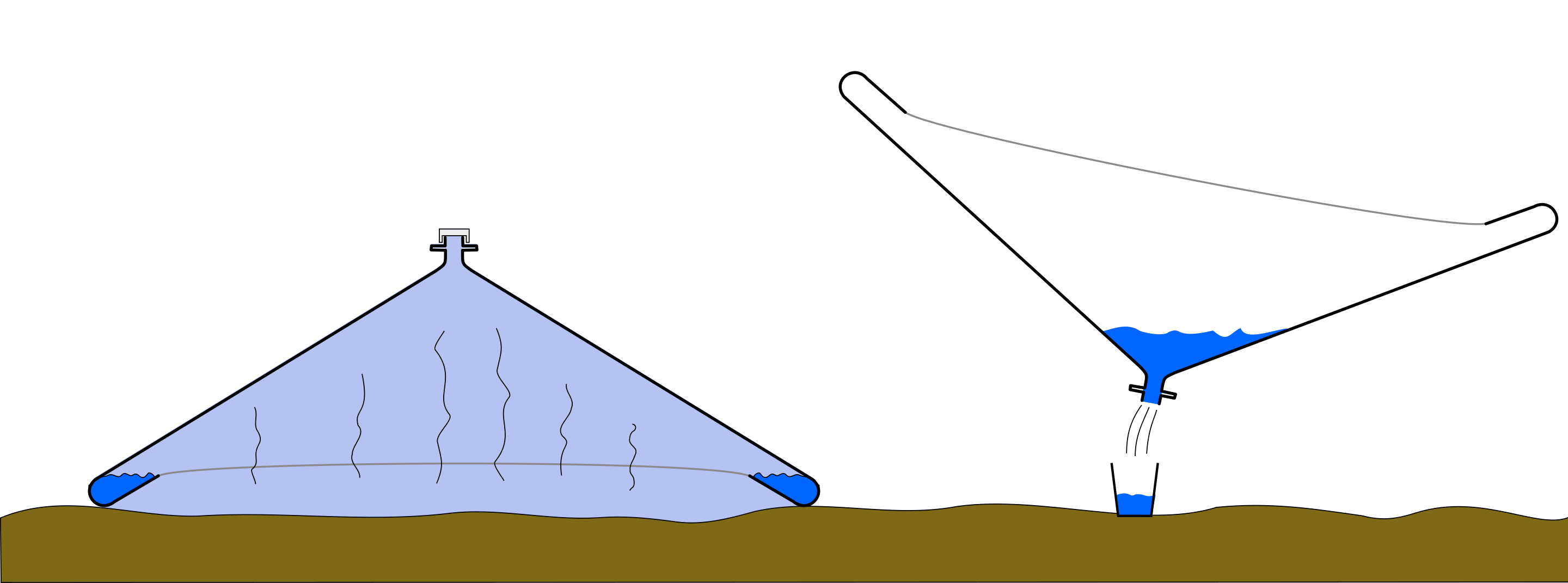
While these stills are cheap and achieve ZLD, they might not be the best option. The energy efficiency is low, particularly because heat can leak out of the system and condensed water can drip back into the brine.
Another problem is the huge land requirements. Because each still only collects a little solar energy and only works during the day, you need a huge amount of space to collect water which can be expensive. The space requirements mean you can’t locate near users, adding transportation costs.
Drum (and spray) drying
Instead of solar stills, let’s use solar panels to heat up water. Solar can collect and utilize energy much more efficiently than solar stills while keeping costs low. How should we use that energy? There are energy-efficient methods like reverse osmosis, electrodialysis, or mechanical vapor compression but they often require expensive equipment that doesn’t play well with the intermittent nature of solar energy.
The more brute-force option is to use the electricity to boil the water directly and condense the steam. Drum driers are the simplest way to do this. Rotary spray drying is another slightly more complicated option that might work well. For drum driers that operate on the outside surface, it’s particularly easy to scrape salt off and maintain the equipment. As the steam exits, it can be condensed on the incoming seawater pipes to recycle the heat.
The combination of solar and a dryer can be low cost and relatively space efficient. The main downside is how much energy is required. Sure we can convert solar energy into heat efficiently and we can recapture much of the heat by condensing steam, but even small heat losses can add up. It takes roughly 700 kWh to boil a cubic meter of seawater, losing even 1% of the heat means more energy use than a lot of other desalination methods. Engineering the drum drying system to recycle the heat back into the incoming water is a challenge. It might even be worthwhile to surround the drum with incoming pipes.
Since we mostly need heat from the solar panels, some form of thermal energy storage (or perhaps large, heavy drums) can smooth out the intermittency and increase equipment utilization. If the thermal storage is cheap enough that gives us room to make the equipment more sophisticated and efficient.
Going nuclear (and geothermal)
Since the simplest processes just boil water, all we need is cheap heat. Nuclear power isn’t the cheapest source of electricity, but can be one of the cheapest sources of high-quality heat. All without any intermittency. Small modular reactors might lower land use and location constraints.
All you have to do is use the heat to warm a metal plate and pour seawater over it. The salt can be scraped off and the steam can be condensed on incoming pipes. Recycling the heat effectively is still important.
Another option is to use the nuclear heat to push the seawater into a supercritical state. This is much harder, but at high enough temperature you have the benefit of directly producing molten salt which can be electrolyzed into pure elements. To make this cost effective, it’s essential to use the supercritical water to recycle atoms and produce high-value chemical products.
Enhanced geothermal could take the place of nuclear in providing cheap heat. A too-clever option is to pipe seawater directly into a carefully sealed borehole to make supercritical water directly. But the corrosion risks make this unworkable.
Both of these methods have the benefit of pretty cheap energy and low intermittency. They can be pretty land efficient but finding a good location can be an issue. The upfront capital costs can be quite high for this option.
Lyophilization
Freezing seawater takes less energy than boiling it and still separates out the salt. However, freezing in bulk still leaves us with a concentrated brine that requires a second drying step. Alternatively, spray freezing would require clever separation techniques to remove salt crystals from the ice.
Another option is to freeze-dry the ice. Ice sublimes directly into gas at a low enough temperature and pressure leaving behind salt. One issue is that this process typically works in batches and takes a while to thoroughly dry the product which lowers productivity (though the salt doesn’t need to be perfectly dry). Fortunately the equipment is pretty cheap.
Conclusion
There are several ways to use new energy sources to desalinate water at lower cost. I haven’t done a formal analysis of these ideas, so it’s unclear whether these approaches would be better in practice.
Mining the salt for resources can be used to boost profits. The salt also contains carbon dioxide which can potentially be converted into fuels. Removing this carbon dioxide may also be worthy of carbon capture subsidies.
Overall I don’t see desalination as a huge bottleneck for human civilization. Better water storage systems and water recycling can often meet increased demand. Desalinated water is already cheap enough that it wouldn’t be a big part of final product costs in general. But if we want to produce freshwater at scale to terraform the Earth, every innovation helps.
Further reading
Coupling a small modular molten salt reactor with desalination
Extreme salt-resisting multistage solar distillation with thermohaline convection
See my post on supercritical water for links on supercritical water desalination.
Over 70% of fresh water is used for agriculture. If you're in a water stressed environment it makes more sense to use hydroponics to save water and use the ultra cheap solar electricity for LEDs (which are also getting increasingly more efficient).
If nuclear could be used for high temperature heat applications, why hasn't it been used so far? Or it has but I'm not aware of it?