
Links #17
Lunar colonies got easier, new brain imaging techniques, demographers ignore population decline, and more


Edit: I added some stuff to point 4 that I meant to write.
1.
I found lots of fun space stuff.
Google is going to use satellites to detect wildfires, another benefit of having more eyes in the sky.
Terran Space Academy has some delightfully opinionated videos on space topics. I particularly liked the videos on Magnetoplasmadynamic Thrusters and Magnetoshell Shields and rotating detonation rocket engines.
AnthroFuturism has a series of videos sketching out how to develop the Moon.
Recent research on lunar samples from the Chang’E-5 mission suggests that we can produce far more hydrogen on the moon than we previously thought. This is important because while the moon has plenty of oxygen, metals, and sporadic sunlight, there is very little carbon and hydrogen needed to make rocket fuels, plastics, and food. If hydrogen can be made locally, it reduces the amount of stuff a lunar colony needs to import from Earth.
CASSIOPeiA Solar Power Satellite (video, website, paper) is interesting, though it looks to clever by half. It seems like the idea is to convert light into a microwave beam that can be sent to Earth. But energy on Earth is cheap and getting cheaper. I’m more interested in using these kinds concepts for beaming power to the moon.
Affordable, rapid bootstrapping of space industry and solar system civilization outlines a crude plan to produce self-sustaining industry on the moon with an initial investment of less than 100 metric tons of equipment and teleoperation of robots; achievable with 1 Starship flight to the moon1. The main point is that nothing prevents bootstrapping in principle, it’s “merely” a huge engineering challenge. Notice that since there are no known commodities that could profitably be sent back to Earth, this would have to be funded by governments or philanthropists (phil-astro-pists?).
Thin Film Isotope Nuclear Engine Rocket (TFINER). A thin sail with a coating of Thorium-228 can achieve delta-V’s of 100 km/s enabling travel throughout our solar system.
Taken together, there’s a natural progression of space technology. We’re using existing launch systems to put many more satellites in space. That’s funding the current revolution in rocket design where we’re throwing every idea we have2 at the problem to see what sticks. After that, it’ll probably be cheap enough to put equipment on the Moon and Mars that can build structures out of local materials with support from Earth. Eventually things like solar sails and space tethers will help move stuff across the solar system and the next step after that is a Dyson swarm I guess.
2.
On Alice Evans’ podcast, Jesus Fernandez Villaverde claims that UN population projections substantially overestimate the number of births to avoid being alarmist. In a (gated) article, John Burn-Murdoch goes into more detail, with a thread on the article by Lyman Stone here. On top of that, several leading demographers held a talk with the premise “[d]emographic science does not support catastrophizing about low birth rates and population ‘collapse’.”
The latter is a perfectly fine position to hold and I’m not panicking about birth rates either. But it’s pretty annoying to see that the people in charge of collecting and interpreting this data are publishing misleading projections and dismissing the risks of slow population growth out of hand. Imagine if climate scientists published projections that showed less warming than their actually was and dismissed the risks!
Playing these sorts of political games has undermined trust in climate scientists and health officials in the past. The noble lie does far more damage than telling the truth. All scientists should communicate the data clearly and steelman public concerns.
3.
Many exciting brain imaging techniques:
Non-destructive X-ray tomography of brain tissue ultrastructure. It looks like you can image cubic millimeters of preserved brain tissue to 40 nm resolution without needing to section it into thin slices and without destroying the tissue. X-ray spectroscopy is expensive, but avoiding cutting up the brain is nice. What I like most is that you might be able to stack this with other techniques, image with x-rays first, then section and image with optical microscopy, then image destructively with CryoEM.
Mind-blowing (pun intended) thread on using expansion microscopy for genome sequencing. The idea is to take a single cell, cut up the genome in-place, expand it, and use fluorescent tags to identify the spatial arrangement of the genome (paper here). This has obvious applications in brain imaging too, interested to hear what neuroscience people have to say about this.
One-step nanoscale expansion microscopy reveals individual protein shapes. This paper fixes proteins in a gel, cuts them up (while leaving the pieces fixed), labels each piece with fluorescent markers, and images them with fluorescent microscopy. That let’s them see these protein structures as well as fancy techniques like CryoEM.
Another new brain imaging technique: Whole-brain spatial transcriptional analysis at cellular resolution leverages a tissue-clearing method (i.e. it makes organs transparent without changing their structure) to sequence RNA while locating it in 3D space. I continue to believe that brain imaging methods will not be a bottleneck for creating digital minds.
Bridging the gap between the connectome and whole-brain activity in C. elegans.
EDIT: E11 bio released A roadmap to scale connectomics to entire mammalian brains.
4.
Exciting economics is often misguided economics. Shout it from the rooftops! Good economic policy is often pretty straightforward: protect peoples market rights, avoid price controls, and use sensible tax systems. Trying to justify more complicated policies is often wrongheaded.
See also: What do economists know? and What economists don't know by Scott Sumner. The answer may surprise you! Just kidding, it’s a call for simple, sound economic policy.
I just found out about the Mirrlees Review (wikipedia) a 2000 page report from a bunch of economists about how to reform the UK’s tax system. You guessed it, they recommend land value tax, taxing negative externalities, income taxes packaged in a simplified tax code. Since experts broadly agree on how to tax, politicians shouldn’t set taxes.
MR linked a “meta-meta analysis” of institutions and pro-social behavior, finding that “… government effectiveness and regulatory freedom positively correlate with pro-social behavior. We find that freedom from each of the following components of regulation; interest rate controls, binding minimum wages, worker dismissal protections, conscription, and administrative requirements; are correlated with prosocial behavior and are inversely correlated with Nash behavior.” I’m not sure how much to trust their methods, but this runs counter to the idea that free markets corrupt people and make them more selfish.
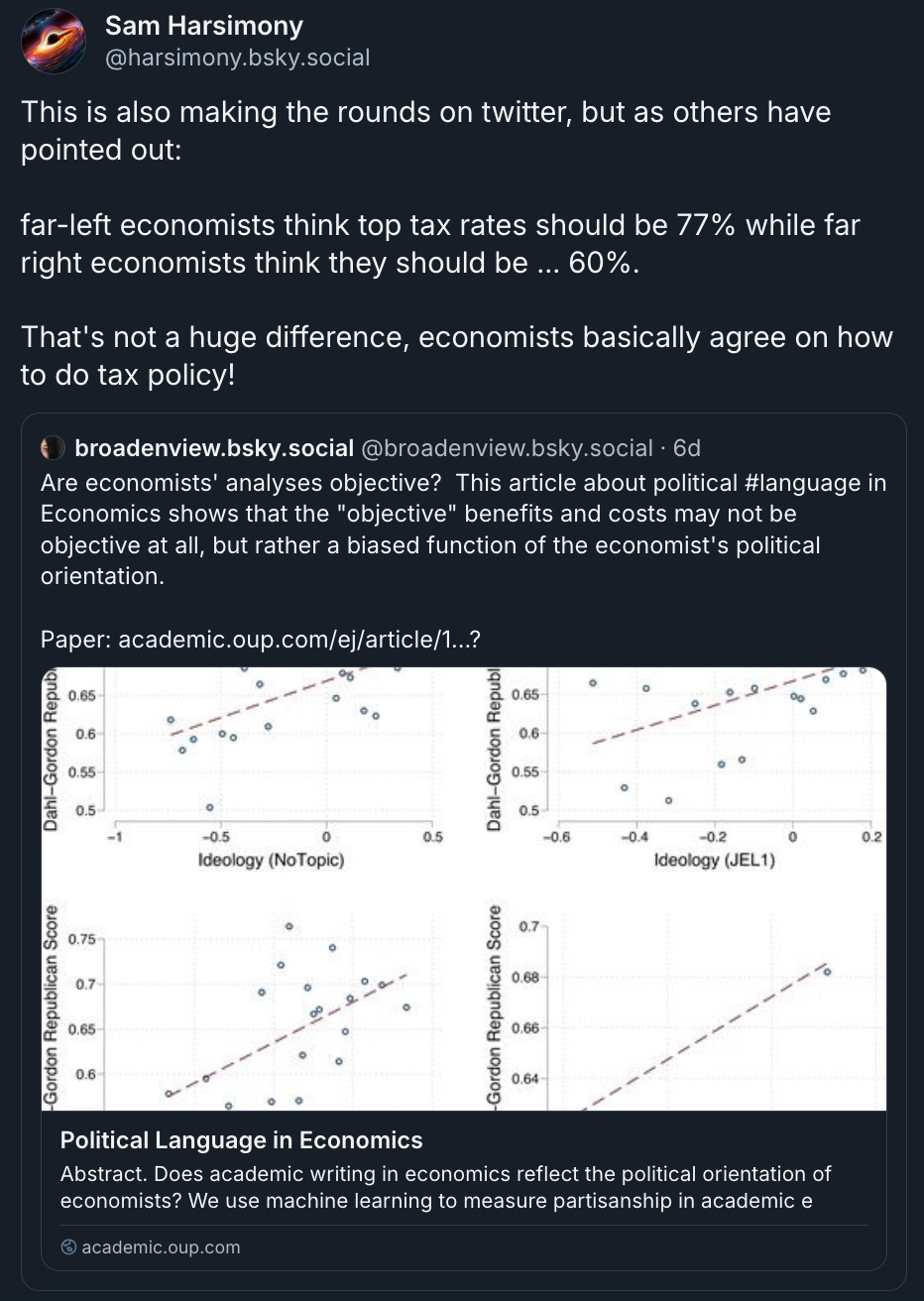
Basically, economic policy is mostly figured out. There’s some disagreement, but most serious people agree on the vast majority of issues, with differences that amount to small tweaks here and there.
Everything else
We can Terraform the American West
More Tomas Pueyo on solar.
Jenny Chase puts up her annual opinions about solar thread. Some quotes:
“1. Solar is the cheapest source of bulk electricity in many countries, and the quickest to deploy, and now you couldn't stop it being built if you wanted to.”
“37. Nigeria is another market to observe closely. In 2023 the government briefly removed subsidies on gasoline for the country’s fleet of private generators, which is much larger than its central power grid. Although gasoline subsidies were reinstated, PV sales continue steadily.”
“40. While moving to a circular economy with 100% recycling rates is essential in the long run, it’s not a challenge for PV in particular; few PV panels have been recycled to date only because the vast majority are still in use. It can be, and is being, done.”
“43. Agrivoltaics is mostly just a buzzword. Whether it means better overall use of land will depend on the precise rules made for local conditions. It needs subsidy, as PV alone is more profit and less work. And there’s a reason we farm big open fields.” (a point against my idea of putting panels over crops).
This video on Spain’s sea of plastic farmland is a good supplement to the discussion of vertical farming in the last linkpost. As expected, covering crops reduces the water and chemicals required for plant production. However, even putting up a little plastic sheeting adds a lot of cost, meaning that it only makes sense to grow high-value crops that are mostly water like peppers, tomatoes, and melons. And these crops need an additional marketing boost as being organic and locally grown to turn a profit. I wonder if anyone has experimented with putting some solar panels on the roof. It would add a lot of cost, but it might keep the interior cool enough in the summer to add another growing season.
Dynamic Scoring: A Progress Report on Why, When, and How. In the US, the Congressional Budget Office estimates cost estimates of proposed legislation but “[b]y design, official budget estimates for legislative proposals generally exclude the proposals’ likely effects on levels of labor, capital, productivity, and other economic outcomes, as well as any feedback effects from changes in those outcomes to the federal budget”. Dynamic scoring would allow the CBO to properly assess the impacts of policies, which seems like a great idea. Giving the CBO more independence and subsidizing prediction markets on these topics could increase accuracy even further.
How stablecoins are Fulfilling Crypto's Original Promise.
So apparently when you use your inner voice to read stuff (subvocalization) your vocal cords move subtly. It’s possible to recognize this inner speech so that computers could potentially hear your thoughts. Why aren’t more people working on this as a brain-computer interface?
Taking AI Welfare Seriously. I’m glad people are working on this.
I suspect they are underestimating the R&D costs, number of shipments for repairs, and difficulty of getting energy to the moon, but overall a program like this could cost less than 100 billion.
Reusable rockets, full flow staged combustion, 3D printed engines, aerospikes, rotating detonation engines, actively cooled heat shields, transpirationally cooled heat shields, magnetoshell shields, and so on. The successful Starship flight 5 incorporated many of these ideas.
I love Casey Handmer's vision. I first came across his idea when he published his piece in Asterisk last year. But I can't get behind Casey's numbers. I work in project finance in solar and battery storage development and the numbers he uses as current prices are way off for what utility-scale solar and storage developers can get for pricing. I'm not saying his idea is wrong, or that we shouldn't do it, but I am saying that it will be more expensive than he is projecting for a number of years.
Folks love talking about how cheap solar panels are getting, but 1) most of those prices are not attainable for projects in the US due to tariffs/restrictions on buying panels from Chinese slave labor 2) modules only are part of the cost stack. I just saw quotes for modules at $0.30/W. NREL shows capex for utility scale solar near $1.50/W, which sounds high to me, I reckon it's closer to $1.10-$1.20/W for large projects (https://atb.nrel.gov/electricity/2024/2023/utility-scale_pv). That link has storage pricing too. Installation costs are getting MORE expensive as labor costs rise. Solar power is cheap, but it's not too cheap to meter, and I don't think it will be for some time yet, if ever.