
How to have more ideas
Notice your thoughts, search the web, write, and review

Over the years, I’ve developed a process for generating and recording ideas that has increased my creativity and helped me professionally.
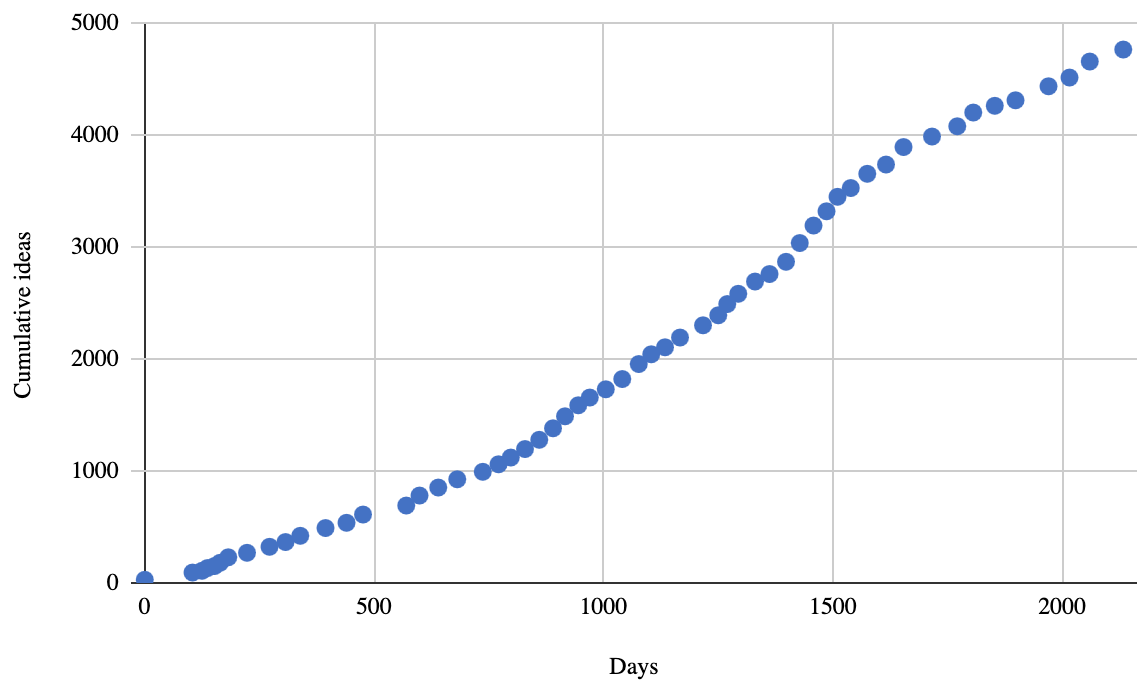
Be aware of where your mind wanders
The thing is, you’re constantly having ideas. Your mind wanders all the time, and if you checked in explicitly, you would notice that you’re considering some pretty interesting stuff. Pay attention to what you’re daydreaming about and catch any questions that pass through your mind during the day. They often lead to something important!
Web search to store thoughts and make connections
When a thought comes to you that’s semi-interesting, just put it into a web search. This is the fastest and least intrusive way to jot something down and often turns up some other interesting results.
It’s fine if the thought is messy or unformed, just put a few keywords into the search bar that will jog your memory later.
Check-in later
Come back to your past web searches every couple of days. Your mind will have continued to process the idea and you’ll find that it’s easier for you to express. Click a few links from the web search if they’re relevant and note any follow-on ideas that come to mind.
Convert these ideas into a more permanent form
Use your favorite note-taking software to write down a more complete version of the idea. You can still write it in a condensed form, but make an effort to explain yourself. I aim to write something in enough detail that a future version of me with no recollection or context can get back up to speed.
This usually takes 1-3 sentences, but a complex idea can be much longer. Keep writing about something as long as you feel motivated, inspiration can be fickle.
Store these notes somewhere you can come back to, I simply order them chronologically by month.
Expand some into a longer form
Some of these ideas are worth writing down in a longer form such as a blog post. For ideas that you have a lot to say about, write an informal piece explaining everything to an imagined audience member. You don’t need to publish anything, but this process will help you generate new ideas and practice your writing.
Annual review
Every year I skim through ideas written in last year and write a condensed list of the most interesting ones. This helps generate new ideas and curates some of your old ideas. Reviews work best when going through ideas that are somewhat old so that you go through the process of re-familiarizing yourself with them.
You can also go through your old idea reviews to look further into the past.
The missing piece: language models
One missing piece in this process is language models. They seem like they could be useful for idea generation, but I haven’t integrated them yet.
They’re capable of understanding and expanding upon ideas, even when written in a condensed form. One day, they could be useful for searching through idea lists and searching the web for inspiration. But so far, I’ve been disappointed with the quality of ideas they produce.
Appendix
There are a couple of other things that help like:
Consuming optimistic, energizing, and interesting media, particularly science and science fiction
Surrounding yourself with optimistic, generative, and active people
Reading and learning new skills
light exercise, walks, long drives, showers
New contexts and experiences
Techniques like Thinkertoys and Oblique Strategies
> Pay attention to what you’re daydreaming about and catch any questions that pass through your mind during the day.
Daydreaming is super-relevant for all sorts of stuff, I think.
What you daydream (automatically mindwander) about usually reflects what your brain (subconsciously, medium-term) cares about, unlike sleeping-dreams which are usually much more random. If I'm making progress on an abstract question, and I notice I occasionally daydream about telling specific others about what I've discovered, then that's a strong clue wrt what *kind of understanding* my brain optimizes for while thinking about it.
And because I've been trying to purify my motivations, I've used what I daydream about as a metric for whether my motivations seem aligned recently. For example, if I've spent too much time on twitter, I can notice that affecting my daydreams (and what sorts of abstract problems I work on) for several days afterwards.
Have you tried creating a so-called Zettelkasten for your ideas?